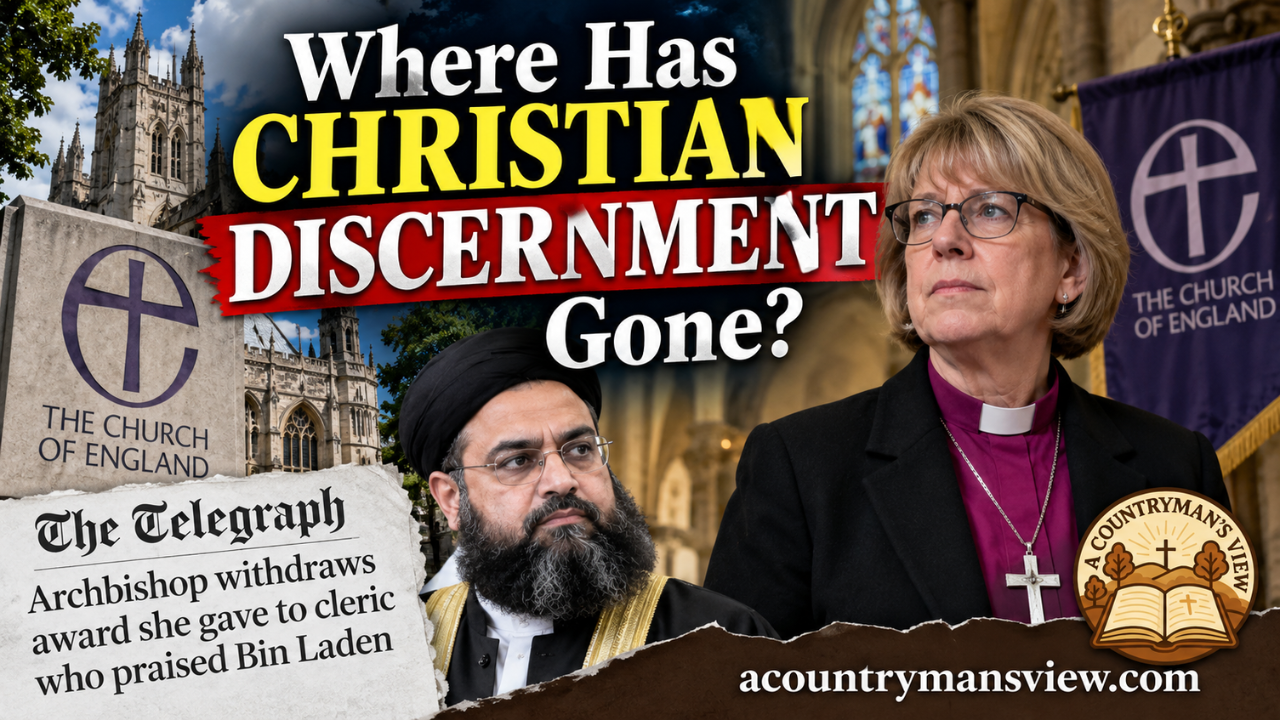

Today I want to talk about where has Christian discernment gone A recent story involving the Church of England caught my attention. It concerned an award for reconciliation and interfaith cooperation that was presented by the Archbishop of Canterbury, Dame Sarah Mullally. The award was later withdrawn after previous comments made by the recipient came to light.
However, I believe this story raises a much bigger issue than one award or one decision. Christians need to ask whether the Church is exercising genuine biblical discernment. We are called to love people and seek peace, but we must never sacrifice the truth of God’s Word in the process.
What Happened at Lambeth Palace?
Hafiz Tahir Ashrafi, chairman of the Pakistan Ulema Council, received the Hubert Walter Award for Reconciliation and Interfaith Cooperation. The presentation took place at Lambeth Palace on September 11, 2026, the 25th anniversary of the terrorist attacks in America.
According to reports, Ashrafi had previously made controversial comments concerning Osama bin Laden. Questions were also raised about reported comments on suicide bombings and Pakistan’s blasphemy laws. His representatives have said that previous remarks were taken out of context and have emphasised his opposition to terrorism and extremism.
Lambeth Palace subsequently announced that the award had been withdrawn. It explained that Ashrafi’s support for religious minorities in Pakistan, particularly Christians, had originally been behind the decision to honour him. However, his previous comments led the Palace to reconsider the award.
The Bigger Question for Christians
It would be easy to concentrate entirely on the controversy surrounding this decision. Yet there is a much more important question for Christians. Where does reconciliation end and compromise begin?
The Bible certainly teaches us to pursue peace. Christians should not be hostile towards Muslims, Jews, Hindus, atheists or people from any other background. Every person should be treated with dignity, and followers of Jesus Christ should demonstrate His love in the way they behave towards others.
Nevertheless, loving someone does not require us to pretend that every belief is true. Nor does respecting another person’s freedom of religion mean abandoning our own convictions. Genuine Christian love must always walk alongside truth.
You may also be interested in my other articles about standing firmly on the truth of God’s Word and the importance of maintaining a genuinely biblical faith.
Jesus Christ Made an Exclusive Claim
When discussing interfaith relationships, Christians cannot simply ignore the words of Jesus. Christ did not present Himself as one possible route to God among many alternatives. His statement in John’s Gospel could hardly be clearer.
John 14:6 NKJV
“Jesus said to him, ‘I am the way, the truth, and the life. No one comes to the Father except through Me.’”
Those words may not fit comfortably with the thinking of our modern world, but Christianity cannot be reshaped simply to make its message more acceptable. If we claim to follow Christ, His words must remain our authority.
That does not give Christians permission to behave arrogantly towards people who disagree with us. Instead, we should speak the truth with humility and love. There is a tremendous difference between graciously disagreeing with someone and changing the Gospel to avoid disagreement.
Christians Need Biblical Discernment
Discernment has always been important for the Church. Scripture repeatedly warns believers not to accept everything simply because it appears religious, compassionate or well intentioned. We are told to test what we hear against the truth of God’s Word.
1 John 4:1 NKJV
“Beloved, do not believe every spirit, but test the spirits, whether they are of God; because many false prophets have gone out into the world.”
Paul gives us another important principle in Romans. Rather than allowing the thinking of the surrounding culture to determine our beliefs, Christians are instructed to have their minds renewed.
Romans 12:2 NKJV
“And do not be conformed to this world, but be transformed by the renewing of your mind, that you may prove what is that good and acceptable and perfect will of God.”
Biblical discernment therefore requires more than following popular opinion. Something can sound compassionate while still conflicting with Scripture. Equally, something can be described as tolerant while gradually moving the Church away from biblical truth.
What Does Reconciliation Really Mean?
There is another interesting aspect of this particular story. The award itself concerned reconciliation, yet reconciliation is also a major biblical theme. Scripture gives Christians what Paul describes as the ministry of reconciliation.
However, biblical reconciliation goes much deeper than bringing different religious groups together. At the heart of the Gospel is the message that sinful human beings can be reconciled to a holy God through Jesus Christ.
2 Corinthians 5:20 NKJV
“Now then, we are ambassadors for Christ, as though God were pleading through us: we implore you on Christ’s behalf, be reconciled to God.”
That is the reconciliation the Church must never lose sight of. Christians can and should work peacefully with their neighbours, including those from other faiths. At the same time, our primary calling remains to proclaim Jesus Christ and the good news of salvation.
I have written more about the Gospel of Jesus Christ and why it remains the central message of Christianity. Whatever changes take place within society or established churches, that message must remain unchanged.
Love Does Not Require Compromise
Unfortunately, our culture increasingly seems to confuse disagreement with hatred. Christians can therefore feel pressured to remain silent about biblical teaching because they fear being described as intolerant. Yet it is entirely possible to love someone while disagreeing profoundly with what they believe.
Jesus demonstrated extraordinary compassion towards people, but He never compromised truth. His love did not prevent Him from speaking clearly about sin, repentance, judgement and salvation. Christians are called to follow that same example.
Our response should never be hatred or hostility towards people of another faith. Instead, we should pray for them, show kindness and be ready to explain the hope we have in Christ. However, we cannot faithfully represent Jesus while denying the uniqueness of who He is.
Is the Church Still Prepared to Stand?
This controversy will eventually disappear from the news cycle, as all news stories do. The underlying question will remain, however. Is the Church still prepared to stand firmly upon God’s Word when biblical teaching conflicts with the values of the surrounding culture?
Christian leaders carry a particular responsibility in this area. Their calling is not merely to follow society or seek approval from the world. They are called to proclaim Christ faithfully and to lead people according to Scripture.
Individual believers have that responsibility too. We should examine what we hear, compare teaching with the Bible and ask God for wisdom. Our confidence must ultimately rest in Scripture rather than institutions, personalities or popular opinion.
For more Christian encouragement, biblical teaching and discussion of current affairs from a Christian perspective, visit A Countryman’s View. You can also read my article on why Christians must remain faithful to Scripture in a changing world.
Final Thoughts
There is nothing wrong with seeking peace or building relationships with people from different backgrounds. Christians should be among the first to demonstrate kindness, compassion and genuine love. Nevertheless, peace must never be purchased by abandoning truth.
Jesus Christ did not say that He was one of many ways to God. He declared that He is the way, the truth and the life. Therefore, whatever direction society takes, the Church must continue to proclaim Him faithfully.
Perhaps the question raised by this controversy is much bigger than whether an award should have been given or withdrawn. If the Church stops proclaiming the truth of Jesus Christ and standing firmly upon the Word of God, what exactly is the Church there for?